Compare NSE BSE Stocks and Follow Company Debates on StocksMantra
Introduction
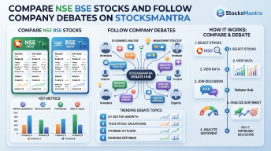
Curious market learners, active equity traders, accounting students, and independent analysts across India look for clear facts about public businesses before studying shares on exchanges, and an organized Indian stock market discussion forum links those conversations directly to individual firms and official filings. StocksMantra works as an informational and community-driven hub for India’s stock market by pairing a searchable directory of NSE and BSE listed companies with dedicated company discussion threads. Rather than acting as a stockbroker, trading venue, or regulated .stocksmantra
Finding NSE and BSE Listed Companies
Browsing a structured NSE BSE listed companies list helps researchers locate company names, exchange listings, trading symbols, scrip codes, ISIN details, mainboard or SME tags, and recorded listing status across the National Stock Exchange and Bombay Stock Exchange before studying a business. StocksMantra shows 6,063 NSE and BSE listed companies in its directory from a platform snapshot dated September 23, 2026. Because listing statuses and identifiers change over time, you verify current details directly on official NSE and BSE portals.
- Scan businesses alphabetically or filter by exchange, segment, and listing status
- Find trading symbols, scrip codes, and ISIN codes in one spot
- Open company pages to view listed details and related discussion threads
- Confirm live listing status through official NSE and BSE disclosures
Checking Stock Identifiers Across Exchanges
Verifying exact identifiers first saves time and prevents costly mix-ups when you examine businesses across the National Stock Exchange and Bombay Stock Exchange.
NSE Stock Symbol Search
An NSE stock symbol acts as a short alphabetic code that identifies a security traded on the National Stock Exchange inside watchlists, quotes, and research notes. Running a careful NSE stock symbol search prevents confusion between companies that share similar names or updated their corporate titles. In a purely fictional example, someone searching for “Harborline Foods” spots a hypothetical firm named Harborline Foods Ltd under symbol HLFOOD alongside a similarly named business using symbol HLAGRO, so checking the full name and exchange listing keeps your research accurate.
- Search by company name when you know the firm but need its ticker
- Search by alphabetic symbol when you spot a short code in market notes
- Match the full corporate name and business activity to avoid lookalike errors
- Confirm active listing status against official exchange records
BSE Scrip Code Search
A BSE scrip code provides a numeric identifier for a listed security on the Bombay Stock Exchange, giving researchers a numerical reference alongside alphabetic trading symbols when a firm trades on one or both exchanges. Using a generic illustration rather than a real company’s code, a firm such as Western Precision Works carries a hypothetical NSE symbol WPWORKS and a hypothetical BSE scrip code 549120, so checking that numeric code against official BSE disclosures protects your notes from mix-ups.
- Find listed securities through their numeric BSE reference code
- Distinguish numeric BSE scrip codes from alphabetic NSE trading symbols
- Cross-check codes from notices, historical tables, and company pages
- Verify every scrip code against official BSE records
ISIN Lookup for Indian Stocks
An ISIN—International Securities Identification Number—supplies a standardized 12-character alphanumeric code across financial systems and depositories to identify a specific security such as an equity share. Performing an ISIN lookup for Indian stocks helps you confirm the exact security behind a company name or exchange code. Since corporate actions, name changes, or capital restructuring alter records, you always verify the ISIN against official exchange or depository disclosures.
- Confirm the exact underlying equity security across financial records
- Cut through confusion from similar company names or exchange code differences
- Double-check ISIN details after name changes or corporate actions
- Verify codes through official exchange or depository sources
| Identifier or Field | What It Identifies | Common Research Use | Verification Reminder |
| Company Name | Registered corporate name of the business | Directories, filings, company pages | Check for name changes and similar names |
| NSE Symbol | Alphabetic trading code on the NSE | Watchlists, quotes, research threads | Match full corporate name and exchange |
| BSE Scrip Code | Numeric security code on the BSE | BSE notices, reference pages, notes | Confirm against official BSE disclosures |
| ISIN | 12-character global security identifier | Security lookup, depository checks | Verify via official exchange or depository records |
Mainboard and SME Listed Companies
Indian exchanges divide listed businesses into mainboard companies and SME listed companies India segments that differ in company scale, listing rules, trading liquidity, and analyst coverage. Smaller businesses often use SME platforms to raise early growth capital. Because SME stocks carry lower liquidity, sharper price swings, and distinct risks compared with larger mainboard companies, you examine disclosures and risks carefully rather than treating an SME or mainboard listing as automatically good or bad.
- Contrast larger mainboard firms against smaller SME platform listings
- Check trading liquidity and order depth before studying smaller shares
- Review financial disclosures and business risks for each company
- Avoid judging any stock solely by its mainboard or SME segment
How an Indian Stock Market Discussion Forum Works
An Indian stock market discussion forum gives members a shared room to examine listed companies, corporate announcements, financial filings, and research methods without chasing unverified tips or noisy social posts. Forum threads capture personal viewpoints and questions rather than professional financial advice, verified financial facts, or guaranteed returns, so beginners and researchers pair community notes with official exchange filings.
- Focus conversations on one company instead of scattered market noise
- Compare how fellow members read earnings releases and business updates
- Watch how experienced participants check filings and separate facts from rumors
- Verify exchange announcements before acting on any forum post
How Company Threads Support Deeper Research
NSE BSE Company Stock Discussions
Focused NSE BSE company stock discussions keep attention on one business over time so you trace how announcements, daily operations, and market reactions connect across quarters. StocksMantra organizes company-centered threads across sections such as Market Discussions, Investing and Analysis, and Community so members follow individual firms alongside public filings without treating forum opinions as verified facts.
- Trace business performance and operational updates for one company
- Track official announcements, management updates, and corporate actions
- Read varied viewpoints on financial statements and industry shifts
- Separate market sentiment and opinions from verified company facts
Fundamental Analysis Discussion
A fundamental analysis discussion Indian stocks thread examines how a business earns money, manages debt, and generates cash rather than focusing solely on short-term price swings. Financial ratios, revenue trends, profit and loss figures, earnings per share, cash flow, business model strength, management track record, and industry standing all matter, yet strong fundamentals or past growth never guarantee future results.
- Examine revenue, profit and loss, earnings per share, debt, and cash flow
- Study the business model, management quality, and industry position
- Read primary financial statements and official filings directly
- Remember past financial performance never guarantees future outcomes
Small Cap Stocks Discussion
Market capitalization—share price multiplied by total shares—helps sort companies into large-cap, mid-cap, and small-cap tiers. Exploring small cap stocks discussion India threads lets researchers see how smaller businesses grow while weighing higher volatility and thinner liquidity. Online threads surface angles to investigate, yet you never rely solely on forum opinions or treat educational notes as stock recommendations.
- Weigh growth potential against execution and business risks
- Watch for higher price volatility and lower trading liquidity
- Check balance sheet strength and official filings independently
- Treat forum posts as discussion points rather than investment advice
Quarterly Results Discussion
A quarterly results discussion Indian stocks thread centers on how a company performed during a quarter compared with earlier quarters and the prior year, helping readers spot trends in sales, margins, costs, and one-time items. Checking official exchange filings keeps the discussion grounded because one quarter’s numbers reflect recent performance rather than a guaranteed future path.
- Compare sequential and year-over-year revenue, margins, and profit
- Spot one-off items versus recurring operating performance
- Review segment details and cost shifts in official filings
- Treat quarterly updates as a snapshot rather than a full forecast
Responsible Community Participation
Joining an Indian stock market discussion forum responsibly means grounding comments in public disclosures and following moderation rules that ban market manipulation, misleading financial claims, spam, and unauthorized personalized investment advice. StocksMantra supports community-driven learning around NSE and BSE listed companies while reminding every reader to verify facts independently and make their own research-backed decisions.
- Align discussions with public filings and community guidelines
- Avoid market manipulation, spam, misleading claims, and unauthorized advice
- Verify company identifiers and disclosures through official exchange sources
- Pair community insights with independent research and personal risk checks
Frequently Asked Questions
Why do newcomers join an Indian stock market discussion forum?
Participants use a forum to discuss listed companies, quarterly updates, corporate announcements, and research methods. Threads help users compare viewpoints and learn, though they never replace official disclosures or licensed financial advice.
How do researchers locate an NSE BSE listed companies list?
Users browse company directories that index listed firms across the National Stock Exchange and Bombay Stock Exchange, then cross-check listings on official NSE and BSE portals. StocksMantra offers a directory of 6,063 NSE and BSE listed companies from a September 23, 2026 snapshot, which users verify for current accuracy.
How does an NSE stock symbol search differ from a BSE scrip code search?
An NSE stock symbol search looks up a company’s alphabetic trading code on the NSE, whereas a BSE scrip code search looks up its numeric scrip code on the BSE. Checking both alongside the full company name prevents mix-ups across exchanges.
Why do analysts run an ISIN lookup for Indian stocks?
An ISIN—International Securities Identification Number—provides a standardized 12-character code that identifies a specific security across financial systems. An ISIN lookup confirms the exact equity security under review and requires verification against official exchange or depository disclosures.
What do retail learners need to know about SME listed companies in India?
SME listed companies operate as smaller enterprises on dedicated SME exchange segments. They often carry different liquidity profiles, disclosure patterns, and business risks than mainboard companies, so investors review filings and risk factors closely rather than assuming every SME stock fits their goals.
How do students join a fundamental analysis discussion on Indian stocks?
Users start by reviewing a company’s financial statements, cash flows, debt position, and business model in official filings, then join a relevant company or investing thread to ask clear, fact-based questions while keeping in mind that past performance never guarantees future results.
What makes a small cap stocks discussion in India helpful?
Helpful threads focus on business fundamentals, balance sheet health, cash flows, liquidity, and official company announcements instead of short-term hype. Small-cap stocks often experience sharper price swings and lower liquidity, making independent checks essential.
How do members approach a quarterly results discussion on Indian stocks?
Readers compare recent performance against prior periods, separate one-time items from core operating trends, and verify every figure against official exchange filings before drawing conclusions from forum comments.
Final Thoughts
Steady equity research grows stronger when you pair exact company identifiers with focused community conversations, treating a listed-company directory and forum as starting points while checking official exchange filings for proof. Platforms like StocksMantra help beginners, traders, and researchers spot businesses and read community viewpoints across NSE and BSE listed companies, yet lasting clarity always rests on your own due diligence, risk awareness, and verified disclosures.stocksmantra
Leave a Reply