Decoding Quantum Tech: Qubits, Circuits, and Algorithms for Newcomers
Introduction
A train timetable in Jharkhand, a UPI payment on a crowded street, a video call with a teammate—ordinary computers handle all of that without breaking a sweat. Ask those same machines to simulate how a new medicine folds inside a human cell or crack a colossal number into primes, and even the biggest supercomputers take ages. That gap explains why engineers, coders, and security folks pay close attention to quantum computing. Instead of pushing current through plain switches, it leans on subatomic physics for narrow, heavy puzzles. If you are starting quantum computing for beginners, you do not need a physics degree on day one. QuantumUting helps newcomers unpack these ideas through clear guides and practical tutorials, and this walkthrough gives you the core pieces in everyday language.quantumuting.com
Getting to Know Quantum Computing Basics
A normal computer moves electricity through tiny silicon switches that stay either off or on. A quantum computer works with tiny physical systems—like trapped ions, superconducting loops, or light particles—that obey quantum mechanics. Picture a regular bit like a rupee coin resting flat on a table: heads or tails. A quantum processor acts closer to a coin spinning on its edge, holding a mix of possibilities until someone stops it to check what came up. Labs and cloud services run early versions of these machines to test chemistry, battery design, and scheduling, while the hardware itself stays delicate and experimental.
What Is a Qubit and Why Does It Matter?
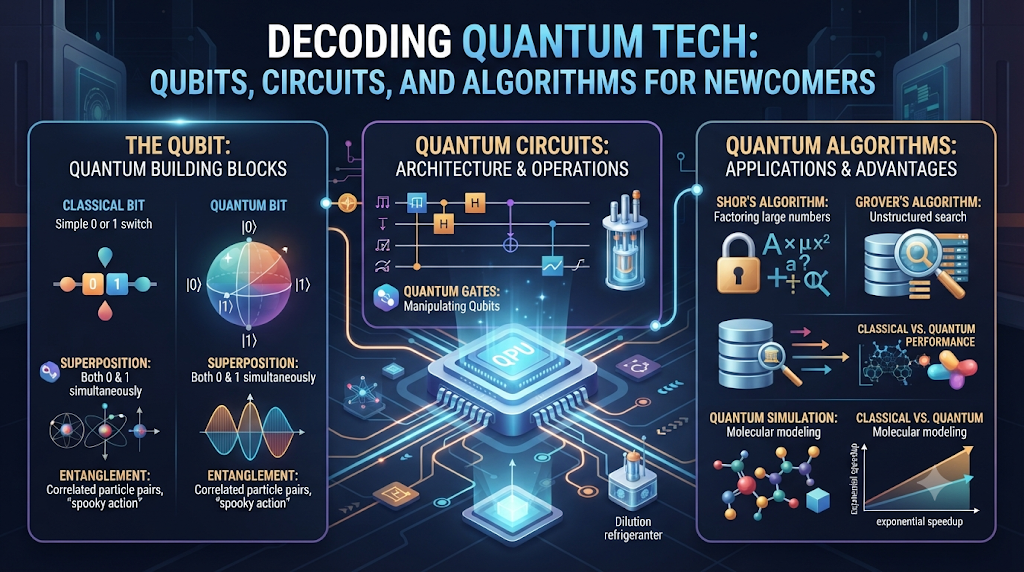
Ask any engineer what is a qubit, and the talk quickly shifts to two strange traits of quantum physics. Short for quantum bit, a qubit is the basic unit of information inside a quantum machine, and it refuses to act like a rigid on-off switch.
- Superposition: A qubit can hold a blend of 0 and 1 at once, letting an algorithm shape probabilities across multiple paths before reading an answer.
- Entanglement: Two or more qubits can link so tightly that checking one immediately tells you something about its partner, even across a wide gap.
- Measurement: Measuring a qubit knocks it out of its delicate state and leaves behind a plain 0 or 1 that a normal screen can show.
Quantum Computing vs Classical Computing: Where Each Wins
Comparing quantum computing vs classical computing is like setting a heavy goods train next to a rally car. Each does a job the other cannot touch. Classical machines are steady, affordable workhorses for web apps, databases, gaming, and daily office tasks. Quantum processors are fragile, high-maintenance tools built for narrow math and physics problems.
| Feature | Classical Computing | Quantum Computing |
| Core Data Unit | Bit (strictly 0 or 1) | Qubit (0, 1, or a superposition of both) |
| Governing Physics | Classical electromagnetism | Quantum mechanics |
| Processing Logic | Standard logic gates (AND, OR, NOT) | Reversible quantum gates |
| Hardware Stability | Reliable at room temperature | Sensitive to heat, vibration, and noise |
| Ideal Workload | Web apps, databases, gaming, daily work | Molecular simulation, factoring, optimization |
Quantum Gates Explained: Steering Qubits Without Heavy Math
Putting a qubit into superposition does not solve a problem on its own. You have to steer it, which is why quantum gates explained simply is so useful. Classical gates overwrite bits as they go. Quantum gates rotate or link qubit states while staying reversible, meaning you can undo the steps mathematically.
- Pauli-X Gate: Flips a 0 to a 1 and a 1 to a 0, acting like a classical NOT gate.
- Hadamard Gate: Moves a plain 0 or 1 into an even superposition of both states.
- Pauli-Z Gate: Leaves 0 alone while flipping the hidden wave phase of 1.
- CNOT Gate: Connects two qubits and flips the second target qubit only when the first control qubit is 1.
Quantum Circuits Tutorial: Reading the Diagram and Testing Code
Think of a quantum circuit like sheet music read from left to right. In this quantum circuits tutorial, each horizontal line stands for one qubit starting at 0, passing through gate boxes, and ending at a measurement symbol on the right. You do not need lab gear to try this. Free Python tools like Qiskit let you build circuits and run simulations right on a normal laptop.
- Start with two qubits, Qubit A and Qubit B, both set to 0 on the left.
- Place a Hadamard gate on Qubit A to put it into a balanced mix of 0 and 1.
- Add a CNOT gate linking Qubit A and Qubit B so their states become entangled.
- Measure both qubits on the right; instead of random static, you get matching pairs of 00 or 11.
Quantum Computing Algorithms Explained: How Interference Finds Answers
A circuit shows the wiring on paper, while an algorithm supplies the math strategy. When looking at quantum computing algorithms explained in plain words, the main trick is interference. Programmers line up gates so wrong answers cancel out like opposing waves, while right answers grow stronger. Grover’s algorithm speeds up searches through unsorted data, and Shor’s algorithm targets prime factors of large numbers. Both show why quantum logic helps on structured math tasks rather than everyday apps.
Shor’s Algorithm Explained: Why Prime Factoring Spooks Security Teams
You often see Shor’s algorithm explained in stories about online security. Created by mathematician Peter Shor, it finds the prime factors of big numbers much faster than known classical methods. Multiplying two huge primes takes a normal computer almost no time. Working backward from that large product to find the original primes would take a classical supercomputer millions of years. Many current security locks rely on that gap. A large, error-corrected quantum computer running Shor’s algorithm could break those locks, though today’s machines are still far too small.
Real-World Applications of Quantum Computing Today and Ahead
Most real-world applications of quantum computing are still in early research and lab testing. Even so, teams are running experiments in several areas to see where quantum processors add real value.
- Drug Discovery: Simulating how molecules interact so researchers can test candidate compounds faster.
- Battery and Material Design: Modeling electron behavior to find better battery materials, solar cells, and catalysts.
- Logistics and Routing: Testing ways to plan delivery routes, schedules, and supply chains more efficiently.
- Financial Risk Modeling: Running complex simulations to study market risk and spot unusual patterns.
- Machine Learning Research: Exploring how quantum circuits might help train or process certain models.
Post-Quantum Cryptography Explained: Preparing Digital Locks Early
Having post-quantum cryptography explained clearly helps keep security planning grounded. Because future large quantum machines could weaken some public-key encryption in use today, engineers are rolling out quantum-resistant defenses. Post-quantum cryptography uses new math problems—such as lattice-based puzzles—that are hard for both classical and quantum computers to crack. It runs as software on regular phones and servers today, unlike hardware-based quantum cryptography that uses physical light signals like photons to share keys.
How to Learn Quantum Computing: Ten Practical Steps to Start
If you want to know how to learn quantum computing, start small and skip heavy physics textbooks at the beginning. A steady sequence of basics and coding works better.
- Brush up on basic math: Review algebra, probability, and how complex numbers work.
- Learn basic linear algebra: Focus on vectors and matrices, since qubit states and gates are written with them.
- Learn core quantum ideas: Read clear explanations of superposition, entanglement, and measurement.
- Practice with gates: Trace how X, H, Z, and CNOT gates change simple inputs.
- Read circuit diagrams: Follow small circuits from left to right on paper to see what comes out.
- Learn basic Python: Get comfortable with simple Python code, lists, and functions.
- Try Qiskit: Install Qiskit and run simulated circuits on your own computer.
- Study basic algorithms: Look at small examples of Deutsch-Jozsa, Grover’s search, and Shor’s factoring.
- Build small projects: Try a quantum random number generator or a simple coin-flip script.
- Practice steadily: Spend a little time each week and keep short notes on what clicks.
Common Mistakes Beginners Should Avoid
Newcomers often run into the same misconceptions early on. Keeping these points in mind helps you avoid wasted effort.
- Assuming quantum computers beat classical ones at everything: They only help on specific math and simulation tasks.
- Thinking a qubit stores two normal bits at once: A qubit holds a probability state, not two separate binary slots.
- Confusing superposition with ordinary parallel computing: Quantum machines do not just test every answer at once like millions of normal CPUs.
- Believing entanglement sends instant messages: Entangled qubits are correlated, but you still need a regular channel to send usable information.
- Expecting classical computers to go away: Classical systems will stay central and work alongside quantum hardware.
- Waiting to master physics before coding: Basic linear algebra and Python are enough to start writing simple circuits.
- Treating lab experiments as finished products: Most quantum tools today are for research, testing, and learning.
How QuantumUting Helps Readers Explore Quantum Technology
Learning a technical subject gets much easier when complex ideas are put into plain language. QuantumUting focuses on decoding the quantum future for students, developers, security professionals, and curious beginners. Through structured guides, Qiskit examples, circuit walkthroughs, and articles on algorithms and post-quantum security, it gives readers a practical place to build knowledge step by step.
Frequently Asked Questions About Quantum Computing
- 1. What is quantum computing in simple words? It is a way of computing that uses quantum physics to solve specialized math and science problems that are tough for regular computers.
- 2. What is a qubit, and how is it different from a bit? A classical bit is 0 or 1, while a qubit can hold a combination of 0 and 1 until measured.
- 3. Is quantum computing better than classical computing? Only for specific problems like molecular simulation or factoring; normal computers are far better for everyday work.
- 4. Do I need to know physics to learn quantum computing? No. Basic linear algebra, probability, and beginner Python are enough to start building circuits.
- 5. What are quantum gates used for? They are operations inside a circuit that change qubit states, create superposition, or entangle qubits.
- 6. How does a quantum circuit work? Qubits move from left to right through gates and finish with a measurement that gives classical 0s and 1s.
- 7. What is Shor’s algorithm used for? It factors large numbers quickly, which matters for public-key encryption.
- 8. Can quantum computers break current encryption? Not today. Current machines are too small, though stronger future ones could threaten older encryption.
- 9. Where can quantum computing be used in real life? Active research covers drug discovery, battery materials, routing and logistics, financial modeling, and machine learning.
- 10. How can a beginner start learning quantum computing? Review basic linear algebra and Python, read beginner guides on qubits and gates, and try simple circuits in Qiskit.
Final thoughts
Think of quantum computing as a specialized toolkit rather than a replacement for everything on your desk. Qubits, gates, circuits, and algorithms follow clear rules that make sense once you test a few examples yourself. Standard machines will keep running daily apps, while quantum systems take on select puzzles in science, logistics, and security. Keep experimenting with small code snippets, read widely, and lean on QuantumUting whenever you want clear tutorials to guide the next step.quantumuting.com
Leave a Reply